

I’ve watched good bettors make terrible bankroll decisions in the Carabao Cup more times than I can count. They’ll spend weeks developing sharp analytical skills, identify genuine value, make brilliant predictions, and then stake way too much on a single match because “this one’s a lock.” Three days later, they’re wondering where half their bankroll went after a reserve goalkeeper has the game of his life or a penalty shootout goes the wrong way.
The Carabao Cup presents unique bankroll management challenges that don’t exist in more stable betting environments. The variance is enormous – rotation makes outcomes unpredictable, one-off knockout matches eliminate the safety net of regression to the mean, and the sheer randomness of penalty shootouts can destroy even the most carefully reasoned positions. If you’re applying Premier League bankroll management principles to cup betting, you’re probably hemorrhaging money without realizing why.
What I’ve learned through painful experience is that protecting your bankroll in volatile markets isn’t about being conservative across the board. It’s about understanding where variance comes from, adjusting your staking to match the uncertainty you’re facing, and building systems that survive inevitable bad runs without going bust. Conservative bankroll management isn’t boring – it’s what allows you to still be betting six months from now when others have blown up their accounts.
This isn’t going to be some generic advice about “never bet more than you can afford to lose” or “always bet the same amount.” That stuff is useless. What I want to show you is a comprehensive framework for managing your bankroll specifically in Carabao Cup betting, accounting for the competition’s unique volatility patterns and helping you maximize long-term growth while controlling downside risk.
Understanding Carabao Cup Variance
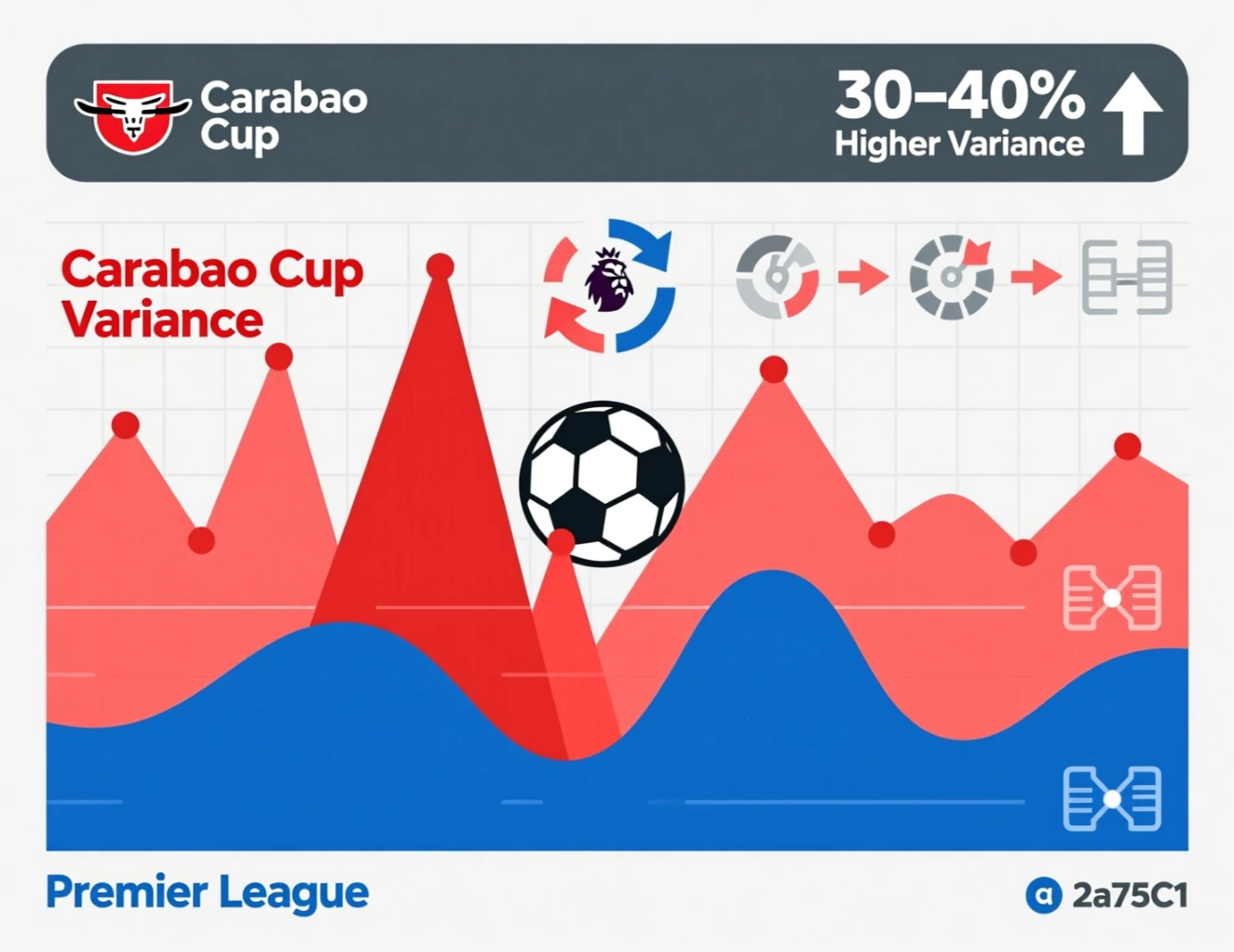
Before discussing staking strategies, you need to understand why the Carabao Cup creates more variance than regular league betting. Variance isn’t just bad luck – it’s mathematical uncertainty inherent in the outcomes you’re betting on, and different betting environments have drastically different variance levels.
Single-elimination knockout football creates what statisticians call “path dependence.” One bad result and you’re out, whereas league football lets results even out over 38 matches. This format dramatically increases short-term variance. A team might genuinely be better than their opposition but lose 40% of the time in one-off matches. That 40% failure rate doesn’t matter much over a full league season, but it matters enormously in knockout competitions.
Heavy rotation makes outcomes less predictable than league matches. When you’ve got established teams with settled lineups, results cluster around expected values more tightly. When managers throw seven or eight reserves onto the pitch, all bets are off. A team that should win 70% of the time with their first XI might only win 55% with reserves. Your edge narrows and variance expands.
Penalty shootouts are literally coin flips with slight edges. When matches go to penalties, you’re essentially gambling on a 50-50 outcome regardless of how much better one team is. The frequency of penalty shootouts in the Carabao Cup – particularly in two-legged semi-finals and earlier rounds between evenly-matched teams – injects pure randomness into results that destroys bankroll management plans built for lower-variance environments.
Low-scoring football amplifies variance too. When matches frequently end 1-0 or 0-0, one moment of brilliance or one defensive mistake decides outcomes. High-scoring matches have more regression to the mean because individual goals matter less. In a 4-3 match, the better team probably won. In a 1-0 match, the better team maybe won, or maybe they just got unlucky.
Quantifying variance helps you adjust bankroll management appropriately. I estimate that standard Carabao Cup match betting has roughly 30-40% higher variance than equivalent Premier League betting. That’s not a precise calculation, but it reflects the combined impact of rotation, knockout format, and penalty shootout frequency. Your staking must account for this increased uncertainty or you’ll experience brutal swings that feel like bad luck but are actually just math.
The Foundation: Determining Your Base Unit
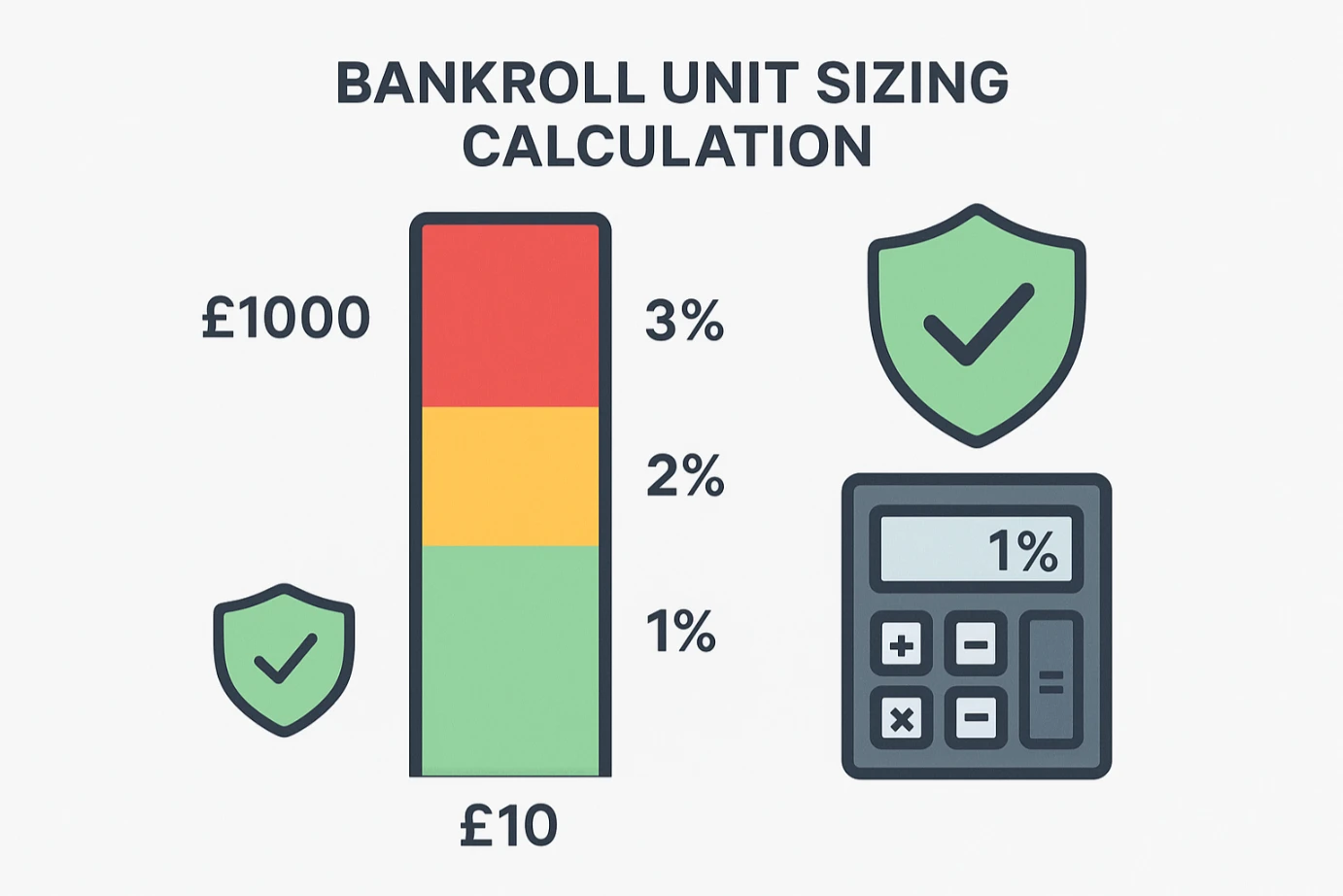
Every bankroll management system starts with determining your base betting unit. This is the foundation from which all staking decisions flow, and getting it wrong undermines everything else. For Carabao Cup betting specifically, I recommend more conservative unit sizing than you’d use for lower-variance markets.
A common recommendation is making your base unit 1-2% of your total bankroll. For a £1,000 bankroll, that’s £10-20 per bet. This sizing provides enough cushion to survive long losing streaks that inevitably occur in volatile markets. The mathematics of ruin shows that betting units above 5% of bankroll creates unacceptably high risk of going bust even with genuine edges.
I personally use 1% base units for Carabao Cup betting, sometimes dropping to 0.5% for particularly uncertain bets. This feels small and unsexy – nobody brags about making £10 bets with a £1,000 bankroll – but it’s what allows you to survive the inevitable 10-bet losing streak that will happen eventually. Conservative unit sizing is the price of admission for long-term profitability.
Your bankroll should be money you can afford to lose completely without affecting your lifestyle. This isn’t moralizing about responsible gambling – it’s practical advice about decision-making under stress. When you’re betting with money you actually need, every loss creates emotional pressure that destroys your analytical discipline. You start chasing losses, overvaluing longshots for quick recovery, and making increasingly desperate decisions.
I keep my betting bankroll completely separate from other finances. It sits in a dedicated account that I never withdraw from except for planned distributions. When it grows, I might take some profits at year-end. When it shrinks, I accept that and don’t deposit more to “get back to even.” This psychological separation prevents the emotional spirals that ruin bankroll management.
Bankroll should also be evaluated separately for different betting activities. Your Carabao Cup bankroll might be £1,000 while you’ve got £3,000 for Premier League betting and £500 for experimental markets. This segmentation helps you track which activities are profitable and prevents disaster in one area from contaminating others. When my Carabao Cup betting hits drawdowns, it doesn’t force me to reduce stakes in other areas where I’m doing well.
Fixed Staking: The Conservative Approach
Fixed staking means betting the same amount on every selection regardless of odds or perceived edge. It’s mathematically suboptimal compared to sophisticated approaches, but it’s psychologically robust and prevents the catastrophic mistakes that more complex systems enable.
With fixed staking, every bet is exactly one unit. Whether you’re betting on Manchester City at 1.20 or Rochdale at 15.00, you stake the same amount. This eliminates decisions about varying stake sizes and prevents you from convincing yourself certain bets deserve more action. The simplicity is valuable when you’re dealing with high-variance environments where your confidence assessments are often wrong.
Fixed staking underperforms optimal strategies when you can accurately assess edge sizes. If you truly know one bet has 10% edge while another has 2% edge, varying stakes accordingly maximizes growth. But in Carabao Cup betting where lineups are uncertain, motivation levels vary wildly, and randomness dominates, your edge assessments are probably less accurate than you think.
The biggest advantage of fixed staking is preventing catastrophic overbetting. When every bet is the same size, you can’t blow up your bankroll on a single “sure thing” that turns out to be anything but. I’ve seen sharp bettors destroy months of profits by staking 10 units on what they thought was incredible value, only to watch reserves throw away a two-goal lead.
Fixed staking also makes record-keeping and analysis simpler. You can easily calculate win rates, average odds, and ROI without adjusting for varying stake sizes. This clarity helps identify whether your betting is genuinely profitable or if you’re just getting lucky on your bigger bets while losing on average.
The main downside is leaving money on the table when you genuinely have huge edges. If you find a bet with 20% edge and only stake one unit, you’re not maximizing value. But in practice, those massive edges are rarer than bettors believe, especially in efficient markets. What feels like 20% edge is often 5% edge plus overconfidence.
Percentage Staking: Adapting to Bankroll Changes
Percentage staking means always betting a fixed percentage of your current bankroll rather than a fixed monetary amount. As your bankroll grows, bet sizes increase. As it shrinks, bet sizes decrease. This creates natural position sizing that prevents going bust while allowing growth.
With 1% staking on a £1,000 bankroll, your first bet is £10. If you win and bankroll grows to £1,010, your next bet is £10.10. If you lose and bankroll drops to £990, your next bet is £9.90. This constant adjustment means you’re always betting appropriately for your current bankroll size rather than your starting bankroll.
The mathematics of percentage staking are compelling. You literally cannot go bust because bet sizes shrink as bankroll decreases. After a 50% drawdown, you’re betting half as much, which helps preserve capital for recovery. During winning streaks, increasing bet sizes compound returns more aggressively than fixed staking.
Percentage staking particularly suits Carabao Cup betting because it automatically adjusts for the high variance. During brutal downswings that are common in knockout competitions, your bet sizes naturally decrease, helping you survive until variance swings back in your favor. You don’t need to manually adjust stakes based on recent results.
The downside is psychological difficulty during losing streaks. Watching your bet sizes shrink from £10 to £7 to £5 feels like going backwards even though it’s mathematically optimal. Many bettors can’t handle this regression and override the system, defeating its purpose. If you’ll struggle with shrinking stakes psychologically, fixed staking might work better despite being mathematically inferior.
I use a modified percentage system where I recalculate stakes weekly rather than after every bet. This provides the benefits of percentage staking while avoiding constant recalculation. Sunday night, I check my bankroll and set stake sizes for the upcoming week. This creates a good balance between adaptability and simplicity.
Kelly Criterion: The Mathematical Optimum
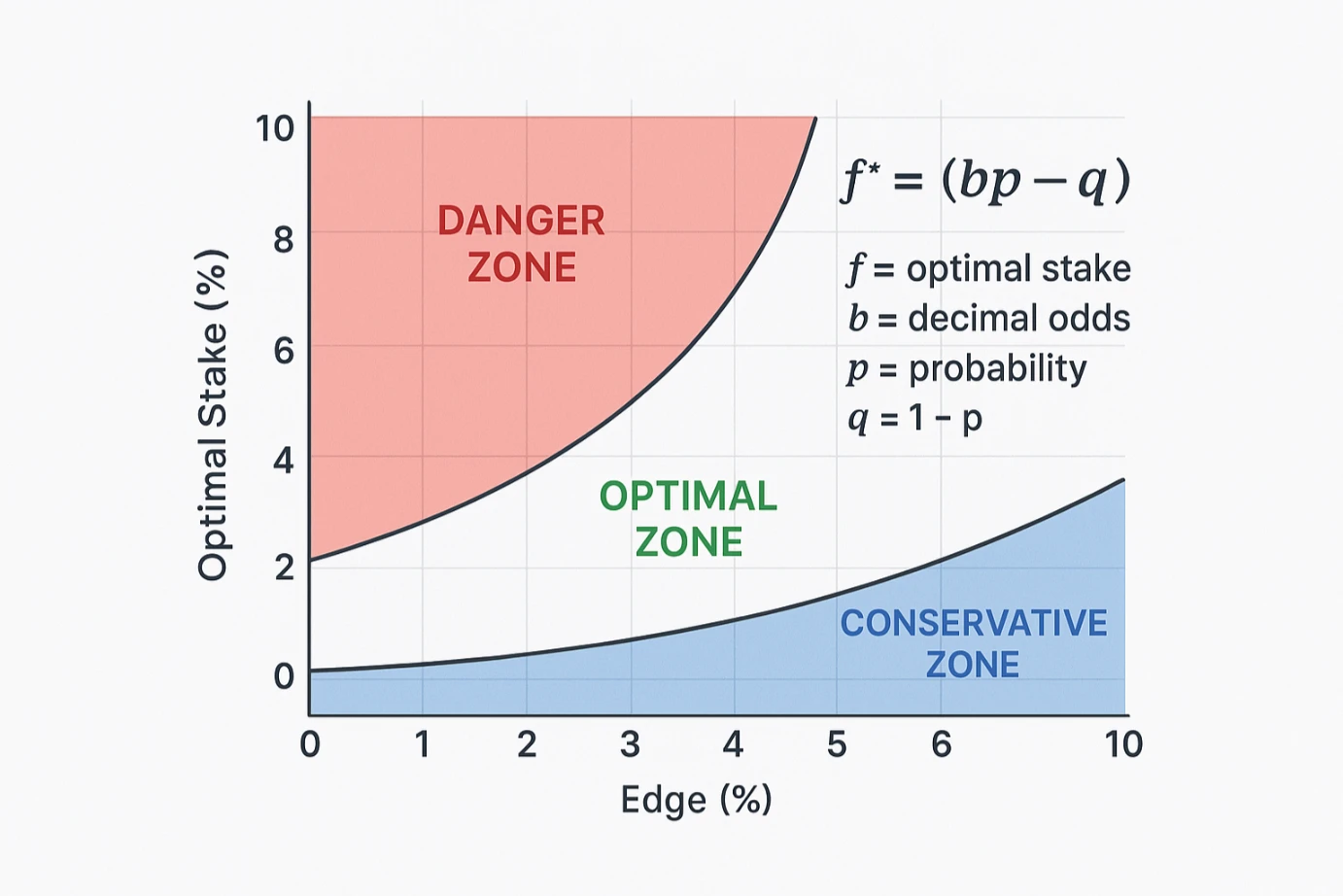
The Kelly Criterion represents the mathematically optimal stake size for maximizing long-term bankroll growth. It tells you exactly what percentage of bankroll to bet based on your edge and the odds offered. In theory, it’s perfect. In practice, it’s dangerous without modifications.
Kelly formula: f = (bp – q) / b, where f is the fraction of bankroll to bet, b is the decimal odds minus 1, p is probability of winning, and q is probability of losing. If you think a 3.00 shot has 40% chance of winning, Kelly suggests betting 10% of bankroll: (2 × 0.4 – 0.6) / 2 = 0.1.
Full Kelly staking is too aggressive for real-world betting. It assumes you know exact probabilities, which you don’t. It assumes infinite betting opportunities, which you don’t have. It creates massive swings that few people can handle psychologically. A series of edges you overestimated will destroy your bankroll faster than you’d believe possible.
Most serious bettors use “fractional Kelly” instead – typically quarter or half Kelly. If full Kelly suggests 10% of bankroll, quarter Kelly means betting 2.5%. This dramatically reduces variance while still providing most of the growth benefits. You’re trading some mathematical optimality for massive reductions in risk and psychological stress.
Kelly becomes particularly problematic in Carabao Cup betting where your edge estimates are uncertain. That reserve-heavy lineup might have 45% or 65% chance of winning – you really don’t know. Using full Kelly with overconfident edge estimates is a recipe for disaster. Conservative fractional Kelly accounts for this uncertainty.
I use Kelly primarily as a ceiling rather than a target. If Kelly suggests betting 8% of bankroll, that tells me I’m probably overestimating my edge or the bet is too risky regardless. My actual bet will be much smaller, but Kelly provides a reality check on maximum reasonable stake sizes.
Tracking and Analysis Systems
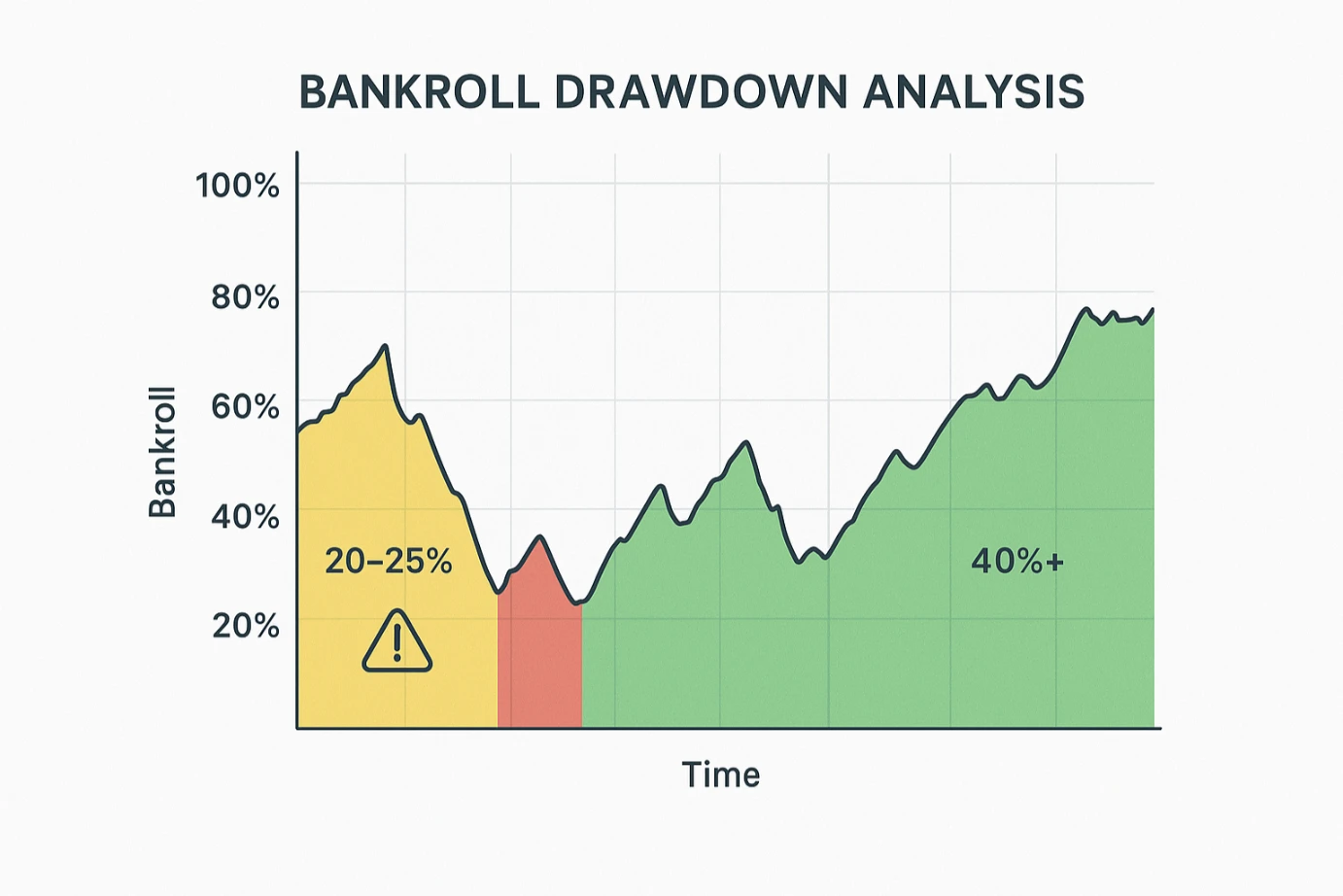
Bankroll management without careful tracking is just gambling with extra steps. You need comprehensive records showing not just wins and losses but stake sizes, odds, bet types, and reasoning. This data reveals whether your management approach is working or needs adjustment.
I track every bet in a spreadsheet with date, match, bet type, odds, stake, result, profit/loss, running bankroll, and notes. This seems excessive but provides invaluable data for analysis. Patterns emerge that you’d never notice otherwise – maybe you’re overbetting cup semifinals or underbetting early round favorites.
Monthly reviews show whether my bankroll management is appropriate. I calculate actual returns, worst drawdowns, win rates across different bet types, and average stakes. This reveals if I’m properly matching stake sizes to edge sizes or if I’m systematically over- or under-betting certain situations.
Return on investment is the key metric, but you need proper sample sizes before drawing conclusions. Over 50 bets, anything can happen. Over 500 bets, patterns emerge clearly. If you’re showing 5% ROI over 500+ bets, your bankroll management is protecting profits effectively. If you’re break-even despite finding value, you’re probably overbetting or mismanaging streaks.
Drawdown analysis shows how much your bankroll declined from peak to trough. If you’re experiencing 40% drawdowns regularly, your stake sizing is too aggressive for the variance you’re facing. Target maximum drawdowns of 20-25% for sustainable long-term betting. Anything beyond that suggests either horrific bad luck or inappropriate stake sizes.
I also track the difference between my largest and smallest bets over time. If that gap keeps widening, I’m probably letting emotions drive stake sizing rather than analytical assessment. Discipline means your largest bets are only 2-3x your smallest bets, not 10x because you convinced yourself you’d “spotted a lock.”
Psychological Aspects of Bankroll Management
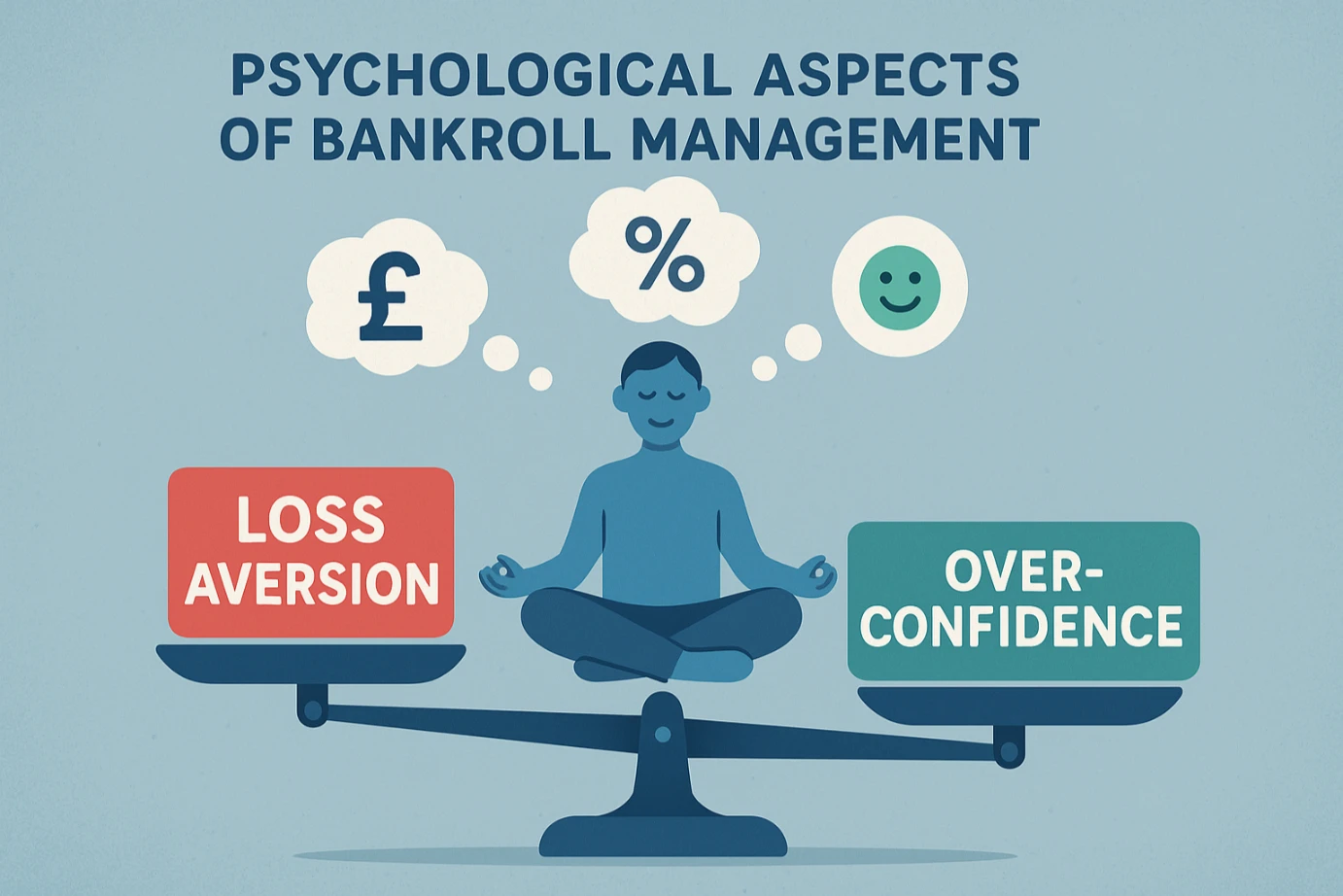
Technical bankroll management systems fail when bettors can’t execute them consistently under psychological pressure. The mental game is frankly more important than the mathematical optimization for most people.
Loss aversion makes losses hurt more than equivalent gains feel good. Losing a £20 bet feels worse than winning a £20 bet feels good. This psychological asymmetry causes all sorts of bad decisions – chasing losses, avoiding +EV bets after bad runs, or making revenge bets to “punish” teams that beat you.
I combat loss aversion by framing everything in terms of expected value rather than results. A losing bet that had 5% edge was a good bet that got unlucky. A winning bet that was -EV was a bad bet that got lucky. Focusing on process rather than outcomes helps maintain discipline when variance swings against you.
Overconfidence after winning streaks is equally dangerous. You start believing you’ve figured something out, that your analysis is sharper than it actually is, and you gradually inflate stake sizes without realizing it. Then variance corrects and suddenly you’re down huge because you were massively over-staked.
I use pre-commitment strategies to defeat psychological biases. Before the betting day starts, I decide my maximum total exposure – maybe 5 units worth of bets. Once I hit that limit, I stop betting regardless of what opportunities appear. This prevents the increasingly aggressive staking that happens when you’re caught up in the action.
Separate your betting from your ego. When bets lose, it doesn’t mean you’re stupid. When bets win, it doesn’t mean you’re a genius. You’re making probabilistic assessments in uncertain environments. Sometimes you’re right, sometimes you’re wrong, and maintaining emotional equilibrium through both is what separates long-term winners from people who blow up their accounts.
Apply these financial rules specifically to the Carabao Cup bankroll model.
The Reinvestment Question
As your bankroll grows through successful betting, you face decisions about whether to reinvest profits or withdraw them. This seems simple but has significant implications for risk management and long-term sustainability.
Aggressive reinvestment means keeping all profits in your bankroll and continuously increasing unit sizes as it grows. A £1,000 bankroll becoming £1,500 means your 1% units grow from £10 to £15. This compounds growth rapidly but also increases your risk exposure. A bad run now costs more in absolute terms even if percentage drawdowns stay constant.
Conservative reinvestment means withdrawing some profits regularly and growing bankroll more slowly. Maybe you withdraw 50% of profits quarterly, so that £1,500 bankroll gets £250 withdrawn, leaving £1,250 for betting. Your unit sizes grow more slowly but you’re locking in profits and reducing risk of giving everything back.
I use a hybrid approach: reinvest all profits until bankroll doubles, then withdraw half and reinvest the rest. So £1,000 grows to £2,000, I withdraw £500 and continue with £1,500. This provides psychological wins through withdrawals while still allowing meaningful bankroll growth.
The Carabao Cup’s high variance argues for more conservative reinvestment than you’d use for stable betting markets. The swings are brutal enough that aggressive reinvestment while running hot can quickly reverse into giving back huge amounts. Regular profit-taking reduces this risk while maintaining growth potential.
Think about reinvestment in terms of risk-adjusted returns rather than absolute growth. Growing bankroll aggressively feels great until a 25% drawdown means losing months of profits in two weeks. Slower growth with profit-taking might underperform in good times but dramatically outperforms over complete boom-bust cycles.
Protecting Profits Long-Term
Bankroll management isn’t about any single bet or even any single season. It’s about still being able to bet profitably years from now. That requires thinking beyond immediate optimization toward long-term sustainability.
Never bet with money you’ll need in the short-term. Your bankroll should be money you could lose completely without affecting your life. This isn’t about “responsible gambling” moralizing – it’s about maintaining decision-making quality. When you need the money, every loss creates panic that destroys your discipline.
Build multiple bankrolls across different activities rather than having everything in one place. My Carabao Cup bankroll is separate from Premier League betting, which is separate from other sports. This diversification means disaster in one area doesn’t end my entire betting operation.
Take regular breaks from betting, especially after sustained losing periods. Sometimes you need distance to reset psychologically and evaluate whether your approach still makes sense. I take one month completely off betting every year, usually during the off-season, to disconnect and return fresh.
Remember that edges are small and variance is high in sports betting generally and Carabao Cup specifically. Even with genuine 5% edges, you need massive volume before random noise averages out to signal. Bankroll management that survives this reality is far more valuable than chasing aggressive growth that frequently leads to ruin.
The goal isn’t getting rich quickly from Carabao Cup betting. The goal is maintaining an edge over years and decades, slowly grinding out profits while surviving the inevitable bad runs. Boring? Maybe. Profitable? Definitely. Sustainable? Absolutely. And sustainability is what separates serious bettors from gambling addicts who eventually give everything back.
Protect your capital on our EFL sportsbook dashboard.
