
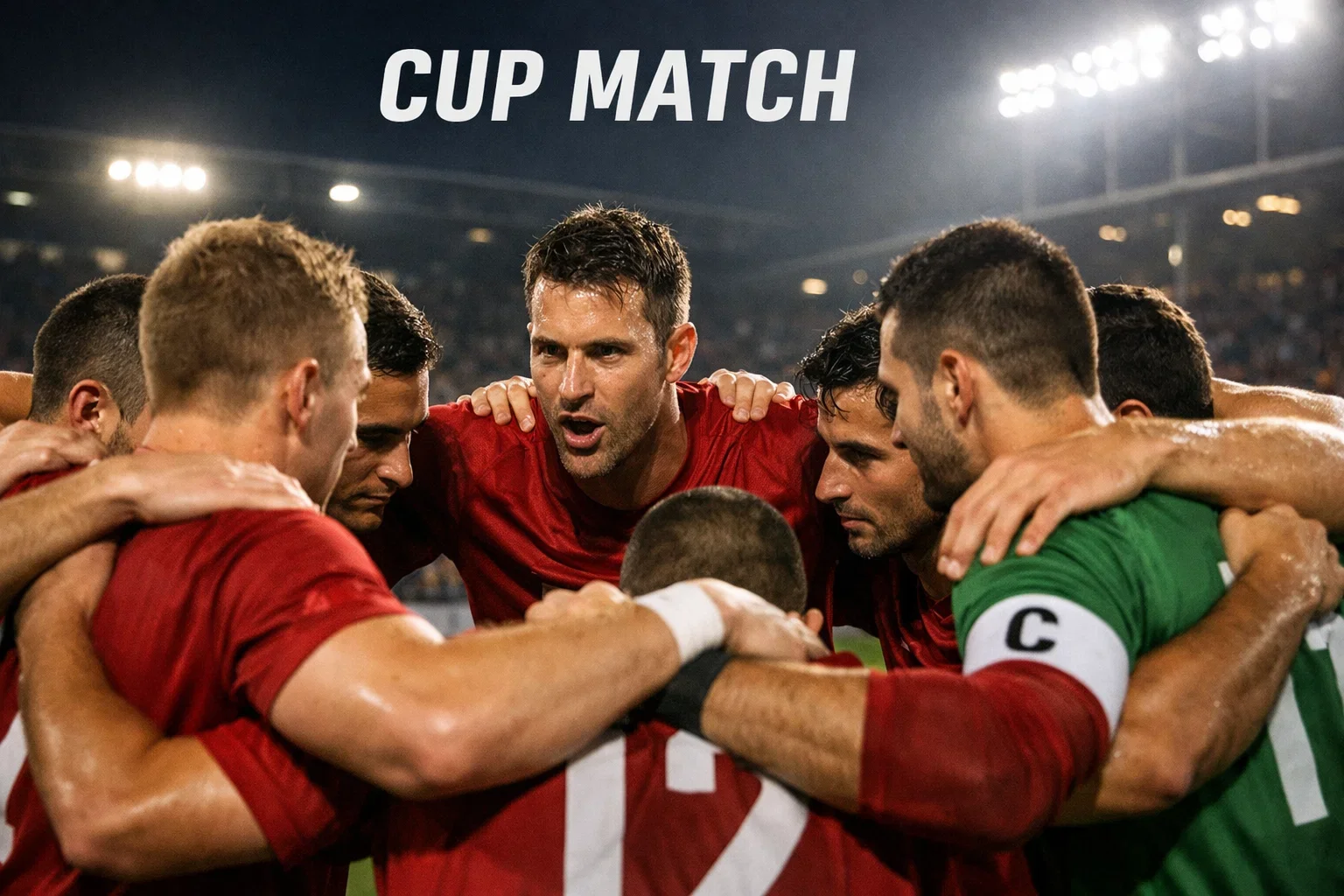
Football betting models typically assume both teams in any match want to win with equal intensity. This assumption holds reasonably well in league competition where three points carry identical value regardless of opponent identity. Cup competition breaks this assumption fundamentally. The Carabao Cup features fixtures where a League Two club playing their biggest match in years faces a Premier League side treating the tie as an inconvenient distraction from serious competitions. Quantifying these motivation differentials represents one of the most valuable—and most difficult—analytical challenges in cup betting.
Motivation affects everything: lineup selection, tactical approach, physical intensity, mental concentration, and response to adversity. A highly motivated team will run harder, compete longer for loose balls, maintain concentration through boring passages, and show resilience when falling behind. An unmotivated team might field quality players who go through motions without maximum effort. The difference produces match dynamics that pure quality analysis cannot predict.
The challenge lies in measuring something inherently psychological and variable. Motivation isn’t directly observable; we infer it from behavior. But developing frameworks for systematic motivation assessment—even imperfect ones—beats ignoring motivation entirely or relying purely on intuition. The methods discussed here provide structure for evaluating motivation differentials that can then inform betting analysis.
Institutional Priority Indicators
Some clubs consistently prioritize the Carabao Cup; others consistently deprioritize it. This institutional orientation persists across managers, seasons, and specific circumstances, making it more predictable than individual match motivation.
Trophy drought provides the strongest institutional motivation signal. Clubs without recent silverware assign higher priority to any available trophy than clubs with recent success. Newcastle hadn’t won a major domestic trophy since 1955 before their 2025 Carabao Cup triumph—the competition mattered enormously to that organization. Manchester City, having won the trophy four consecutive times recently, assigns lower relative priority because silverware is expected rather than exceptional.
European competition access through cup victory affects priority. Winning the Carabao Cup provides Europa Conference League qualification (currently), which matters significantly to clubs outside traditional European qualification positions. A mid-table Premier League club without realistic top-six hopes might view the cup as their European pathway, elevating priority beyond pure trophy value.
Club culture and supporter expectations influence institutional orientation. Liverpool’s ten Carabao Cup victories create institutional identity around the competition—supporters expect serious effort regardless of squad rotation. Other elite clubs have weaker cup traditions that produce lower supporter expectation and consequently lower institutional priority.
Financial incentives scale inversely with club size. Prize money matters more to lower-league clubs with modest budgets. A third-round appearance generating significant gate receipts and television payments meaningfully affects League One club finances. The same amounts are irrelevant to Premier League clubs whose weekly wage bills exceed total cup prize money. This differential creates genuine motivation asymmetry.
Motivation is heavily influenced by Premier League managers and their rotation policies.
Manager-Specific Motivation Patterns

Managers bring individual philosophies about cup competition that override institutional tendencies. Some managers treat every match as an opportunity to build winning mentality; others explicitly deprioritize cups to manage player workload for more important competitions.
Manager career stage affects cup priority. New managers seeking to establish themselves often prioritize immediate silverware that demonstrates capability. Managers early in tenures might view cup progression as job security insurance. Established managers with proven records may prioritize league position or European competition where stakes are higher.
Previous cup history reveals persistent patterns. Pep Guardiola’s domestic cup success across Barcelona, Bayern Munich, and Manchester City demonstrates consistent cup prioritization. Other elite managers show weaker cup records that suggest systematic deprioritization. Track manager-specific cup performance relative to league quality level.
Press conference language provides motivation signals. Managers who discuss “respecting the competition” while emphasizing “squad management opportunities” signal lower priority than managers who explicitly target trophy pursuit. Pre-match comments about “important cup ties” versus “difficult scheduling” reveal priority levels that affect likely approach.
Recent results affect cup priority through psychological mechanisms. Teams struggling in league competition sometimes embrace cups as confidence-building opportunities, paradoxically elevating cup priority when league form declines. Teams riding league success might view cups as unnecessary risk to momentum. Monitor league form as context for cup motivation assessment.
Player-Level Motivation Variables
Individual player motivation creates within-team variation that affects overall performance. Some players approach cup ties with maximum effort; others coast through rotation appearances.
Contract situations affect individual motivation. Players in contract years seeking moves need strong performances to attract interest. Cup ties provide showcase opportunities, especially for rotation players who rarely start league matches. Identifying contract-year players in expected cup lineups suggests elevated individual effort.
Career stage influences cup approach. Young players seeking breakthrough treat every appearance as crucial audition. Veterans comfortable with their careers might approach cup rotation as recovery opportunity. International players needing match fitness before tournaments might treat cups as preparation. Map individual career circumstances to likely motivation levels.
Personal rivalries and history create match-specific motivation. Players facing former clubs, hometown teams, or perceived rivals bring elevated emotional investment that affects performance. These factors rarely appear in systematic models but can significantly affect individual motivation in specific fixtures.
Minutes hunger affects rotated players’ intensity. Players who haven’t featured in league matches bring accumulated motivation to cup appearances. First-team regulars grudgingly playing cup ties might not match this hunger. Consider recent playing time when assessing likely effort levels from individual players.
Quantifying Motivation Differentials
Building formal motivation scoring requires identifying measurable proxies for the psychological states we’re trying to capture. No perfect measurement exists, but several approaches provide useful approximation.
Trophy drought years create a continuous motivation variable. A club without trophies for 70 years (Newcastle pre-2025) receives higher motivation scores than clubs with recent success. Weight recent drought more heavily than distant drought—ten trophy-less years for a big club matters more than the same drought for a historically smaller club.
League position relative to expectation indicates distraction level. Clubs fighting relegation or competing for titles face league stakes that dwarf cup importance. Clubs comfortable in mid-table without European pressure have fewer competing priorities. Model league position as motivation modifier.
Fixture proximity provides motivation context. A team playing crucial league matches immediately before and after cup ties faces schedule pressure that affects cup intensity. A team with relaxed surrounding fixtures can invest fully in cup competition. Map fixture context to available intensity.
Round-specific motivation represents systematic pattern. Early rounds feature maximum motivation differential between lower-league maximum effort and elite club squad management. Later rounds see motivation convergence as stakes increase. Model declining motivation advantage for underdogs as rounds progress.
Practical Application
Combine institutional, manager, and player motivation factors into composite assessment for each team, then compare across the fixture to identify motivation differential. When lower-league clubs show maximum motivation against deprioritizing Premier League opposition, back underdogs more aggressively on handicap lines or qualification markets.
Motivation assessment should modify pure quality-based predictions rather than replace them. A highly motivated League One club still faces quality disadvantage against even a rotating Premier League side. Motivation narrows the gap without eliminating it. Adjust odds-implied probabilities by motivation-based factors to identify value.
Live betting captures motivation expression. Teams whose pre-match motivation assessment proves accurate through early intensity deserve continued support. Teams whose predicted high motivation doesn’t materialize in early match phases may warrant reduced confidence. Use in-play observation to validate pre-match motivation assessment.
Accept that motivation assessment involves subjective judgment that formal models capture imperfectly. Your assessment might prove wrong in specific cases. But systematic attention to motivation factors—even imperfect assessment—beats ignoring motivation entirely, which guarantees you miss significant predictive information that affects cup outcomes.
The most sophisticated cup bettors combine quality analysis with motivation assessment, recognizing that both factors shape match dynamics. Pure quality models miss motivation; pure motivation reasoning ignores that better teams usually win. Integration produces better predictions than either approach alone.
Analyze team desires on our knockout wagering platform.
