
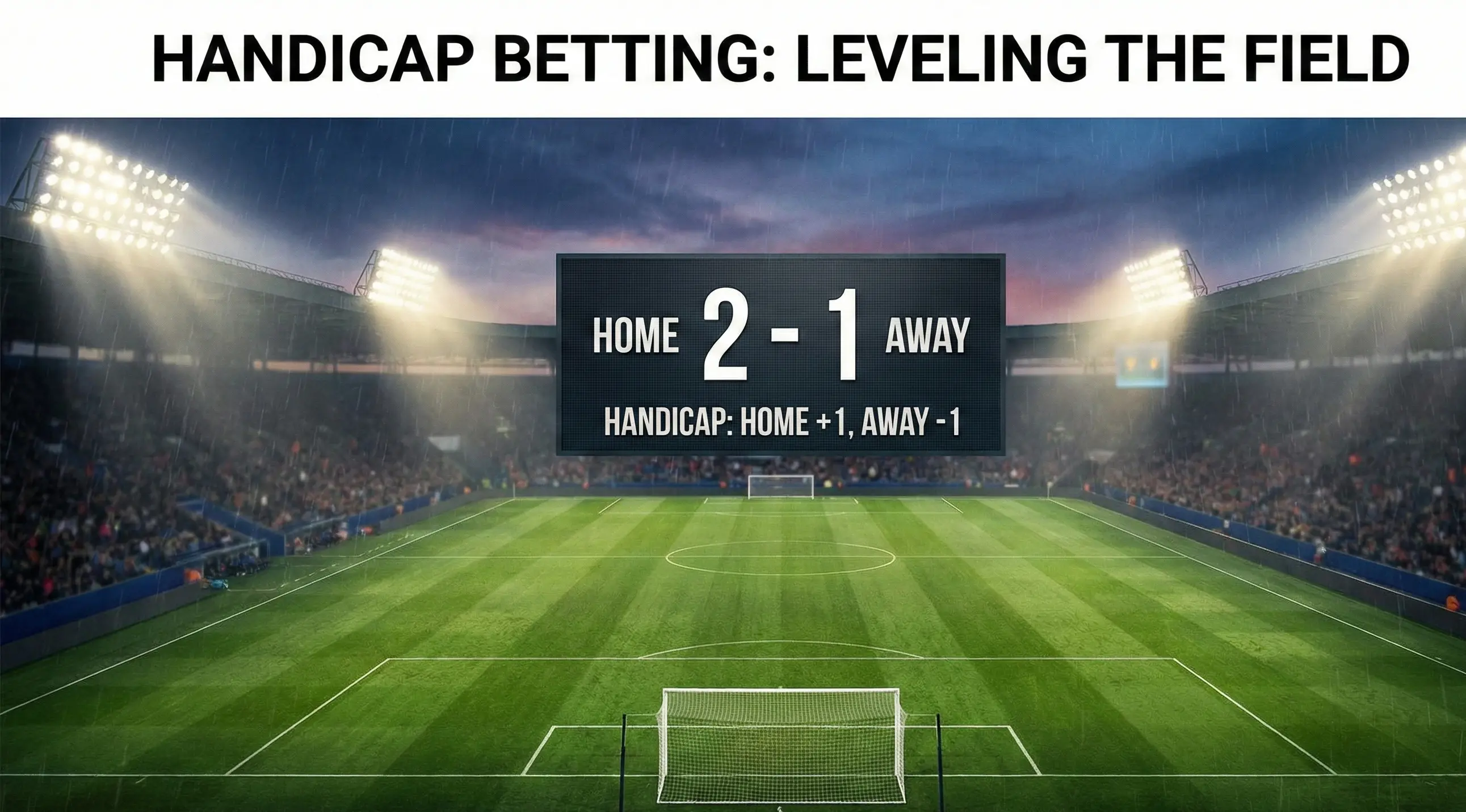
Asian handicap betting eliminates the draw—football’s most unpredictable outcome—by applying goal handicaps that force a winner in every market. For Carabao Cup betting, where rotation and motivation create systematic uncertainty around match results, Asian handicaps offer risk management tools that traditional 1X2 markets can’t provide. Understanding how these markets work and when to use them transforms cup betting from volatile gambling into structured position-taking.
The system originated in Indonesia and spread globally because it addresses football’s fundamental pricing challenge: approximately 25% of matches end in draws, creating a third outcome that complicates traditional betting. By handicapping one team with virtual goal advantages or disadvantages, Asian markets create two-way propositions with roughly equal winning probability. For bettors, this means better odds on favorites, protection options on underdogs, and sophisticated hedging possibilities unavailable in standard markets.
Cup football’s unpredictability makes Asian handicaps particularly valuable. When Manchester City faces lower-league opposition with a heavily rotated lineup, they remain heavy favorites but the margin of victory becomes uncertain. Traditional match betting might offer City at 1.10 odds—unattractive even with high confidence. Asian handicap markets let you bet City to win by specific margins at odds that actually reward successful analysis.
How Asian Handicaps Work
The basic concept assigns goal handicaps before kickoff. A -1.5 handicap on the favorite means they start 1.5 goals behind for betting purposes—they must win by two or more goals for the bet to succeed. A +1.5 handicap on the underdog means they start 1.5 goals ahead—they win the bet unless losing by two or more goals.
Half-goal handicaps (0.5, 1.5, 2.5) eliminate pushes entirely. Since teams can’t score half-goals, every result produces a winner. A team at -1.5 either covers (winning by 2+) or doesn’t (winning by 1, drawing, or losing). This binary clarity simplifies analysis and eliminates the draw as a separate outcome.
Whole-goal handicaps (0, 1, 2) create push possibilities. If you back a team at -1 and they win by exactly one goal, your stake returns—neither winning nor losing. This provides insurance against marginal outcomes but reduces potential profit compared to half-goal equivalents.
Quarter-goal handicaps (0.25, 0.75, 1.25, 1.75) split your stake between adjacent lines. A -1.25 handicap places half your stake on -1 and half on -1.5. If the team wins by exactly one goal, you push on the -1 portion and lose on the -1.5 portion—returning half your stake overall. These lines allow fine-tuning when you think the true probability falls between standard intervals.
The 0 handicap—also called Draw No Bet—returns stakes if the match draws. This provides complete protection against the most unpredictable outcome. When backing a team you believe will win but worry might draw, 0 handicap offers insurance at the cost of reduced odds compared to outright win betting.
When Asian Handicaps Create Value

Mismatched cup fixtures present ideal Asian handicap scenarios. Premier League clubs facing League Two opposition will win almost every time—but will they win by two goals? Three? Five? Traditional markets price only the win; Asian handicaps price the margin.
Consider Arsenal hosting a League Two club in the third round with a rotated lineup. Traditional match betting offers Arsenal at perhaps 1.15—risking £100 to profit £15 feels unappealing. But Arsenal -2.5 might price at 1.85, and Arsenal -3.5 at 2.40. If you believe Arsenal will win comfortably despite rotation, these lines offer meaningful returns on convictions that traditional markets don’t reward.
Conversely, underdog handicaps provide protection when backing giant-killing potential. A Championship club at +1.5 against a rotating Premier League side might price at 1.75. This selection wins if the underdog wins, draws, or loses by just one goal—covering most realistic outcomes where the upset thesis proves partially correct. You’re betting on competitive performance rather than outright victory.
Live betting applications multiply in cup football. Match states evolve—goals, red cards, injuries—and Asian handicap lines adjust accordingly. If your pre-match analysis suggested value on an underdog +1.5 but the match starts with an early favorite goal, the live +1.5 line improves. Managing positions across changing match circumstances becomes possible when you’re not locked into win-lose-draw outcomes.
Strategic Applications for Cup Football
The level ball (0 handicap) serves specific cup functions. When elite clubs rotate heavily against moderate opposition, confident predictions become difficult. Backing the favorite at 0 handicap means winning if they win by any margin while recovering stakes on draws. This conservative approach suits fixtures where favorite victory seems likely but not certain enough to justify short win odds.
Backing +0.25 on underdogs provides partial protection beyond level ball. This splits your stake between 0 (draw no bet) and +0.5 (win or draw wins). If the underdog draws, you win half and push half. If they lose by any margin, you lose entirely. This suits situations where you believe in underdog competitiveness but lack confidence in their winning outright.
Backing -0.25 on favorites positions between outright win and level ball. Half your stake requires the favorite to win by any margin while the other half pushes on draws. This accepts reduced returns on wins in exchange for partial draw protection—useful when facing rotated favorites where single-goal victories feel most likely.
Handicap selection depends on your actual prediction. If you believe a favorite will win by two goals, -1.5 offers the correct expression. If you believe they’ll win comfortably by three or more, -2.5 captures that conviction. Selecting handicaps that match your genuine expectations—rather than chasing higher odds on unlikely margins—produces sustainable results.
Managing Cup-Specific Uncertainty
Rotation uncertainty creates specific handicapping challenges. Lineups aren’t confirmed until sixty minutes before kickoff, but handicap markets price throughout the week. Early markets incorporate assumed rotation—if actual lineups prove stronger or weaker than expected, odds adjust.
Betting before lineup confirmation makes sense when you have conviction about outcomes regardless of rotation. If you believe a Premier League club will beat League Two opposition by three goals whether they field first-choice or second-choice players, locking in early -2.5 lines captures value before public money adjusts prices.
Betting after lineup confirmation makes sense when rotation degree materially affects your prediction. If you believe Arsenal’s first-choice XI would win by four goals but their B-team might struggle to win by two, waiting for lineup news before selecting handicap levels improves accuracy at the cost of potentially worse odds.
Combining pre-match and in-play approaches provides maximum flexibility. Take a position before kickoff based on expected value, then adjust in-play as match circumstances reveal whether your thesis is developing correctly. Asian handicap markets’ continuous pricing throughout matches enables this dynamic management in ways that traditional markets don’t support.
Common Mistakes and How to Avoid Them

Chasing big handicaps on favorites destroys bankrolls. Arsenal -4.5 at 3.50 odds looks attractive against League Two opposition—but fourth-tier clubs sometimes defend capably, matches sometimes lack intensity, and four-goal margins require everything to proceed perfectly. The odds look generous precisely because bookmakers know these outcomes are genuinely uncertain.
Ignoring stake allocation across split handicaps causes confusion. When you bet £100 on a quarter-goal handicap like -1.25, you’re placing £50 on -1 and £50 on -1.5. Understanding this split prevents surprise when results produce partial wins or losses. The complexity isn’t a feature to exploit—it’s arithmetic to understand.
Treating Asian handicaps as value bets by default misses the point. These markets aren’t inherently better or worse than traditional betting—they’re different tools for different purposes. Use handicaps when they express your prediction more accurately than 1X2 markets, not because you’ve read that “sharps use Asian handicaps.”
Neglecting to shop for handicap lines wastes edge. Different bookmakers offer different handicap options and prices. The same fixture might offer -1.5 at 1.90 in one market and 1.85 in another. Since handicap betting often involves close margins, line shopping matters more than in traditional markets where odds differences feel less significant.
Asian handicap betting suits bettors who think in margins rather than binary outcomes. Cup football’s uncertainty makes this margin-thinking particularly valuable—you’re often more confident about competitive dynamics than absolute results. Learning to translate analytical conclusions into appropriate handicap selections converts cup football’s unpredictability from obstacle into opportunity.
